
I believe knot-tying would be a great, life-long skill to have, especially being able to know which knots work best for different situations, like when the rope is thick and not very flexible or bendable.
I have lots of nylon rope and fishing line of various diameters, but don’t know where to begin and/or the best way to get started. My goal is to make this a long-term hobby and spend 1-2 hours per week improving my knot-tying knowledge, skill, and speed.
animatedknots.com - amazing step by step on how to properly tie things. The downside is that there are a lot of knots that are either hyper specific or more decorative than anything. I climb and sail - both are knot-heavy. 95%of the time I use one of five or six knots/hitches. I’d focus on the utilitarian knots personally. These are the knots that can accomplish real stuff - but if you get them wrong, could be fatal in the wrong circumstances.
- Simple overhand - great for keeping a loose end from flopping around, connecting two ropes (need long tails or a secondary knot to keep it from moving), or joining webbing (known as a water knot in this context)
- bowline - great for tying around things like if you want to anchor something to a tree
- figure 8 - the go-to for tying yourself into a rope when climbing. I rarely use it anywhere else as it’s bulky and difficult to untie if loaded hard. A bowline can be used in its place for tying in, but the big advantage of the 8 is that it’s easy to visually check. Every few years a miss-tied bowline kills a climber.
- clove hitch - this one is super underrated. It looks like you just wrapped a rope around something but it self tightens thanks to the way the strands lie over each other. It’s also super easy to adjust.
- trucker hitch - it’s really just a couple of overhand knots, but this one is my default for lashing down loads because you can get the rope super tight. This is how I tie my canoe down to the roof of the car.
- fisherman knots - killer for connecting ropes - or making non-load-bearing adjustable loops (bracelets, necklaces), or tidying up loose ends.
Bonus knots *alpine butterfly - gives you a load bearing loop in the middle of a rope without requiring access to the ends. An overhand on a bight also gives a loop, but the overhand can move when loaded. Alpine butterfly stays where you put it, looks cool, and is fun and easy to tie. *prussic - this hitch can slide along a rope when unloaded and then locks when you apply weight. This let’s you move up or down a fixed line. A Texas Prussic involves one prussic attached to your harness and one free but with a foot loop. Hang on the harness prussic, slide the unloaded foot one up the rope. Stand up on the foot one (locks in place) and slide the unweighted harness loop up the rope, sit back down in your harness. Congrats, you just ascended 100mm up a rope. Rinse and repeat until you get to the top or reverse the process to go back down.
I have been slowly learning 2 knots and practicing them every weekend for the past 6 weeks. I wanted to ask how useful is the “tarp corner knot” in climbing and/or general outdoor activities? My local climbing gym 1 hour away includes a free 2-week membership if you pay $65 for their 90 minute beginner group lesson (capped at 6 climbing noobs) for people who have never climbed before, so I thought it might be useful for that maybe? Here is the link to a 10-second video showing the knot: https://www.youtube.com/watch?v=h_Fjq4xt68I
I’ve never had use for it personally. It’s good for securing the corner (and only the corner) of a tarp with a blown grommet. I can’t think of much in the way of other uses. Makes for a super cool social media video though - I’m itching to try it out.
Just be careful not to overdo it!
NSFW, nudity
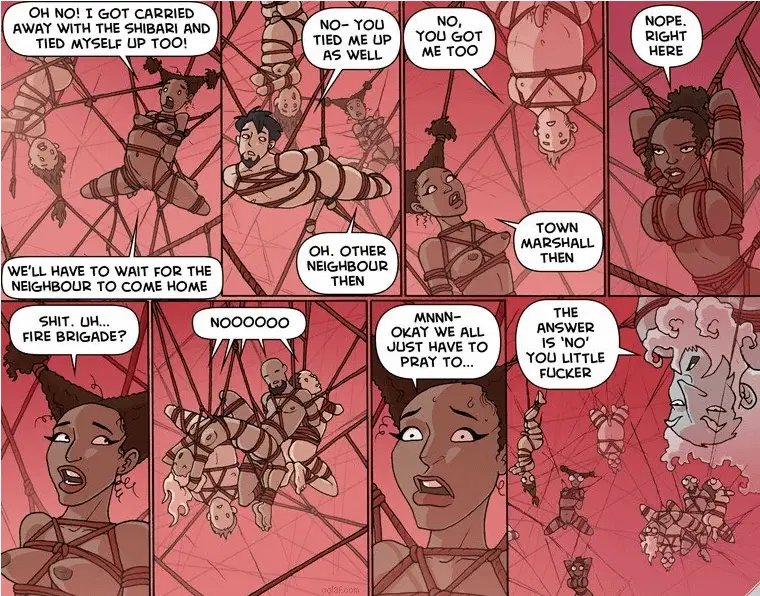
Oglaf, if anybody wonders where the equally funny and kinky comics are from.
70% are genuinely funny, 20% are a normal situation, but someone has their dick out for no reason and 10% are just completely incomprehensible.
I love it.
Fill yer boots mate!
Top three that I use on a regular basis
Bowline (quick knot that’s strong, a common error is that when you try to pull it tight it falls apart, dont panic, you just went the wrong way through the loop you make in step 1)
Sheet bend (a bowline that’s gone horribly wrong somewhere (you’ll get that joke after a bit of practice)lmao but theknot can attach two completely different ropes together)
Figure 8 loop (like a bowline but no matter how much weight you put in the loop it’s still easy to undo)
Reef knot - the most common way to tie two ends together
Monkeys fist (impractical unless you’re throwing ropes into trees, but real fun to make out of old climbing rope if you’ve got pets.
If you want to save your hands and your floor from being shredded and filled with tiny shards of nylon fiber, pick up some of the stuff that has a core and a woven cover from a local hardware store or talk to an outdoor shop to see if theyve got any unusable lengths.
I picked up some Dyneema offcuts dirt cheap from a local sailing chandler’s on ebay (Dyneema’s the brand name for an often overpriced rope made from UHMWPE - “Ultra high molecular weight poly ethylene”, same material as plastic bags but DENSE and as a result hilariously strong- my 3mm thick rope can pull 1 ton before breaking, shit’s WILD)
Once you learn something you need to put it into action.
OP needs to make a swing on a tree branch at the park or get into bdsm.
it’s not going to stick unless you have an application for it.
like, learn the knots that you would actually use in real life or for your hobbies.
Others have covered the practical use knots, so I want to throw a couple fun ones out there:
- Double carrick bend
- Monkey’s fist
If you’re into crafts, friendship bracelets use half hitches. Macrame and tatting are also variations on tying knots in patterns.