

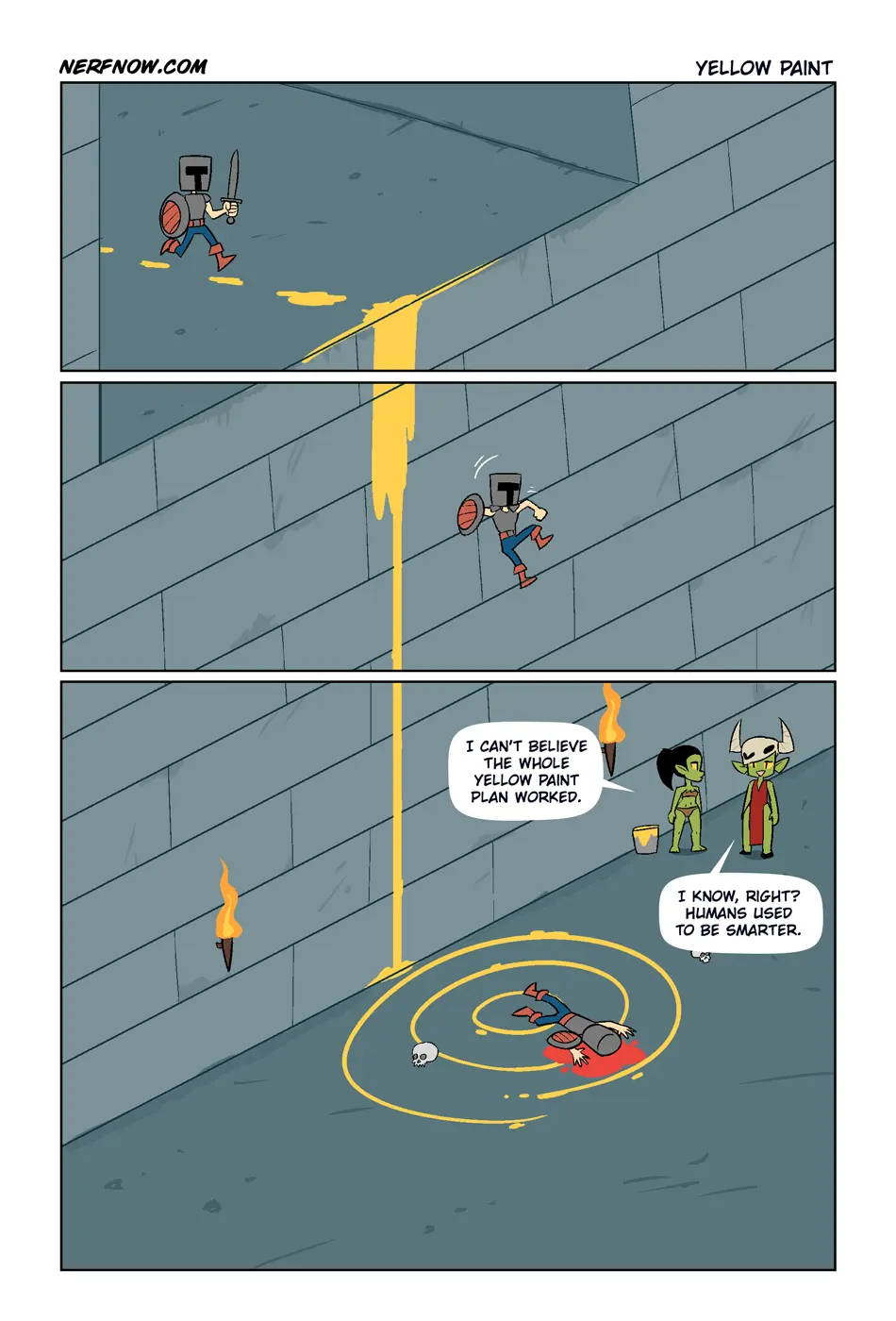
Alt text:
I don’t mind yellow paint as much as it is a sign of the broader issue of big games trying to be idiot-proof. If a game has yellow paint I expect it to be as easy as it can be outside of giving me literal god mode.
Alt text:
I don’t mind yellow paint as much as it is a sign of the broader issue of big games trying to be idiot-proof. If a game has yellow paint I expect it to be as easy as it can be outside of giving me literal god mode.
I haven’t played the Half Life games, but they do firmly fall into the low-fidelity-environment category. Lower fidelity environments don’t need such a clear design language, because any object that exists usually exists for a clear purpose.
Doors, turrets, cubes, switches, one type of “portallable” wall, that’s it. Everything else is just an obstacle. They spent the first half of the game training the player which objects are interactible, and in the second half they didn’t introduce anything new that wasn’t just an obstacle (except maybe the doors, don’t remember if they exist in the first half).
But that’s just the point: If there’s not a lot of stuff in the game and all the objects are clearly recognizable, there’s no need for yellow paint because the game world is yellow paint.
Yellow paint becomes necessary when the game is high-fidelity and trying to be photorealistic and thus stuff isn’t quite as clearly understandable. That’s why we use yellow paint in real life for mark ledges that you could stumble over or emergency exits (ok, here it’s green), or first-aid kits (here it’s red), or defibrilators (blue or green) and so on. We do use this technique in real-life.